

Yesterday morning as I worked on my next book, Devotions From Exodus Part Two, I was pondering the measurements of the Table of Showbread. I had to dig through my Mamaw Lola’s sewing kit to find a measuring tape, because I was not going out to the cold garage to find my husband’s. I crawled around the house yesterday morning measuring the tables in our house looking for a visual of the actual size of the table.
When I first read the measurements I thought, good grief that’s small. But after crawling around a bit, I realized hmmmm maybe it was not as small as I thought. Then another thought hit me, I wonder what the average size of a manger in the time of Christ would have been? As I pondered this thought, my gut got its usual anticipation butterflies. The connection that the Table of Showbread in the Tabernacle held the bread of the Presence and that the manger in a stable held the Bread of Life just would not stop bouncing around in there! So me and the Holy Spirit went on an internet search 🙂
And here is some of of what I found…
“The idea that a woman about to give birth cannot find shelter and assistance from the village women in a Middle Eastern village, even if she is a total stranger, staggers the imagination. We are pressed to affirm on the basis of everything we know of Middle Eastern village life that Joseph most likely sought out and found adequate shelter in Bethlehem. This shelter, we assume, was an occupied private home, for it had a guest room that was full (as we will discover).
What then of the manger? The text tells us, “She gave birth to her first son, wrapped him in swaddling clothes and laid him in a manger.” The traditional understanding of this verse in the Western world moves along the following path. Jesus was laid in a manger. Mangers are naturally found in animal stables. Ergo, Jesus was born in a stable. However, in the one-room peasant homes of Palestine and Lebanon, the manger is built into the floor of the house. The standard one-room village home consists of a living area for the family (Arabicmastaba), mangers built into the floor for feeding the animals (mostly at night), and a small area approximately four feet lower than the living area into which the family cow or donkey is brought at night (Arabic ka’al-bayt).

The family animals were kept in the one-room house at night, but taken out early each morning.
The text of the New Testament itself alludes to the one-room peasant home in Matthew 5:15 where it states that a lamp is put on a lampstand so that it “gives light to all who are in the house.” Obviously, the house must have one room if a single lamp shines on everyone in it. Furthermore, the one-room house with a lower end for the animals is presupposed in Luke 13:10–17. The family ox and/or donkey was brought into the house at night and taken out early each morning. Thus, everyone knew that every family with any animals carried out this simple domestic chore at the start of each new day. To leave the animals in the house during the day was socially and culturally unthinkable. All of this is presupposed by the text. Jesus knew the head of the synagogue had untied his animals that very morning and led them out of the house. With calm assurance Jesus could announce to his face that he did, in fact, lead his animals out that very morning, confident there would be no reply. Were animals kept in a separate stable, the head of the synagogue could have saved face by asserting firmly, “I never touch the animals on the Sabbath.” But if he tried to claim that he leaves the animals in the house all day, the people in the synagogue would ridicule him with laughter! In short, no one would believe him. Thus the debate ends simply, “As he said this, all his adversaries were put to shame” (v.17). Thus, in the case of Luke 2:7, any Palestinian reading the phrase, “She laid him in a manger,” would immediately assume that the birth took place in a private home, because he knows that mangers are built into the floor of the raised terrace of the peasant home.
This assumption is an important part of the story. The shepherds were told that the presence of the baby in a manger was a sign for them. Shepherds were near the bottom of the social ladder and indeed, their profession was declared unclean by some of their rabbis.10 Many places would not welcome them. In many homes they would feel their poverty and be ashamed of their low estate. But no—they faced no humiliation as they visited that child, for he was laid in a manger. That is, he was born in a simple peasant home with the mangers in the family room. He was one of them. With that assurance they left with haste.”
~ Associates for Biblical Research
Is this not some really good info!
Here is a little more…
The gospel of Luke contains specific details regarding Jesus’ birth in Bethlehem of Judea. One of the things mentioned in this narrative is that he was placed in a “manger” (Luke 2:7, 12, and 16).
So Joseph also went up from the town of Nazareth in Galilee to Judea, to Bethlehem the town of David, … and she gave birth to her firstborn, a son. She wrapped him in cloths and placed him in a manger, because there was no room for them in the inn. And there were shepherds … find a baby wrapped in cloths and lying in a manger … found Mary and Joseph, and the baby, who was lying in the manger.
The Greek word φαντη that is used here typically refers to a stone type trough that was used for feeding of animals—sometimes in the stalls within a dwelling.
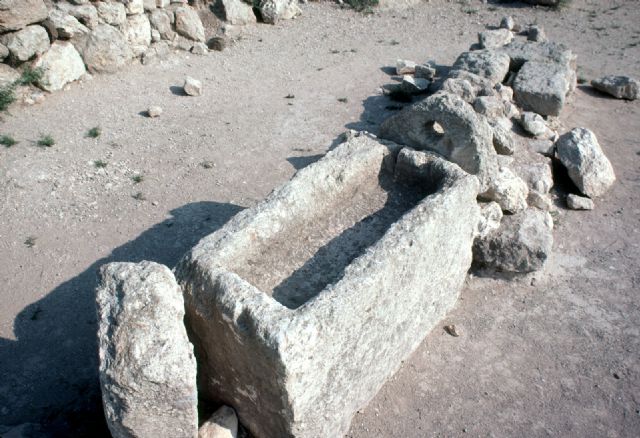
This word is used once more in the Gospels (Luke 13:15) where it refers to a “stall” (NIV), actually a feeding trough, for a donkey—and it is clear from the context that this was within a house (Luke 13:10–17).
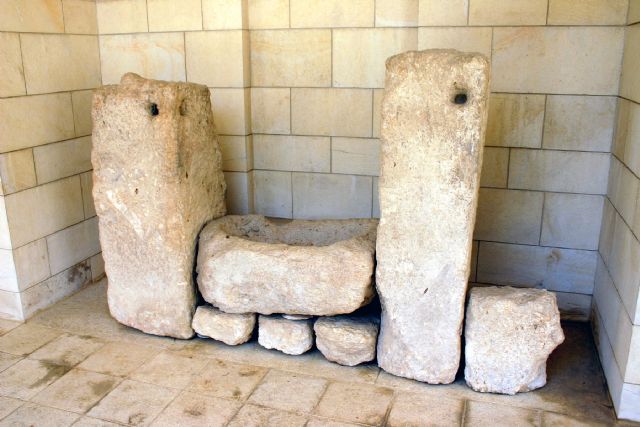
The Lord answered him, “You hypocrites! Doesn’t each of you on the Sabbath untie his ox or donkey from the stall (φαντη; “manger“) and lead it out to give it water?
It appears that after the birth of Jesus, that he was actually placed in a feeding trough somewhat similar to the ones presented here if not ones that were carved into the stone floor of the “stable”—a far cry from the rickety wooden “mangers” of Christmas pageants
I found this extremely interesting!
I love biblical research. The words of our Lord make so much more sense to me and resonate so much deeper when I take the time to dig into the details. This is why the Lord laid the Devotions Through the Torah on my heart. I write the devotionals to hopefully help anyone reading see the beauty and relevance of the Scriptures to there everyday life… because God ALWAYS intended for His Word to be flesh… to be lived out.
Pingback: » In A Manger?